

Let’s talk about the word agentic.
MIT Sloan defines agentic as, “a class of AI [that] integrates with other software systems to complete tasks independently or with minimal human supervision.”1 How this relates to recruiting is interesting, because if you recall walking the conference expo halls over the last few years, you’ll have heard claims of agentic AI that may have been a bit premature. To no fault of these companies own, (I guess?). There’s incredible pressure to build a product with AI that can pass a sniff test in a demo environment, bring that product to market with discerning branding (could do a whole post on branding and messaging fails), partner with analysts, and unlock product-market fit. To which Brad Feld of Foundry reminds us, “Every time you work on something new, whether it’s a new feature, a new product, or a new product line, recognize that you are searching for incremental product/market fit. The search is a continuous and never ending quest. Don’t confuse illusion with reality.”2
Unfortunately, for many failed recruiting vendors we’ve seen come and go in this AI race the last few years, product-market fit has been viewed as a milestone by young founders. It’s not something you “get to”. This has all occurred while the traditional saas model for products at the top of the funnel (enriching personal data for outreach and CRM functions) has been absolutely decimated. There’s been a collapse. And “agentic” has felt a bit like a choose-your-own-adventure in recruiting product marketing and lofty founder conference presentations, at the expense of the buyer.
Until now.
Loxo just announced the launch of Next Generation Loxo and its Agentic Workforce. They’re pushing the envelope, and it’s stuffed with receipts.
For the last few years, I’ve been following the industry closely and working with founders to understand how they’re actually building agentic AI for us. Plus asking where AI should or shouldn’t sit in recruiting process design. What stands out with Loxo’s release comparatively, is how clearly they’ve drawn that line vs. vendors who claim to have agentic AI, adding the phrase to their marketing sites as soon as the word appeared in our techno vernacular in late 2024.
So let’s break this release down a bit and talk about Loxo’s agent workforce. I spoke with Matt Chambers, CEO, in depth. What I learned is this:
Every Loxo agent is proprietary, pre-trained on the craft, tested, and governed before it ever gets anywhere near company data or recruiting workflows.
Loxo’s agents can take a search from hiring manager intake through sourcing strategy, market mapping, candidate evaluation, and a ranked shortlist. Then the recruiter decides who to pursue.
This actually matters more than most recruiting tech buyers might not be paying attention to. There’s a ton of work between opening a req and getting to a quality shortlist. Go ask your friendly, neighborhood RecOps professional. And from first principles thinking in recruiting, the highest value a recruiter can deliver is the shortlist.
Here’s a look at what you need to know:
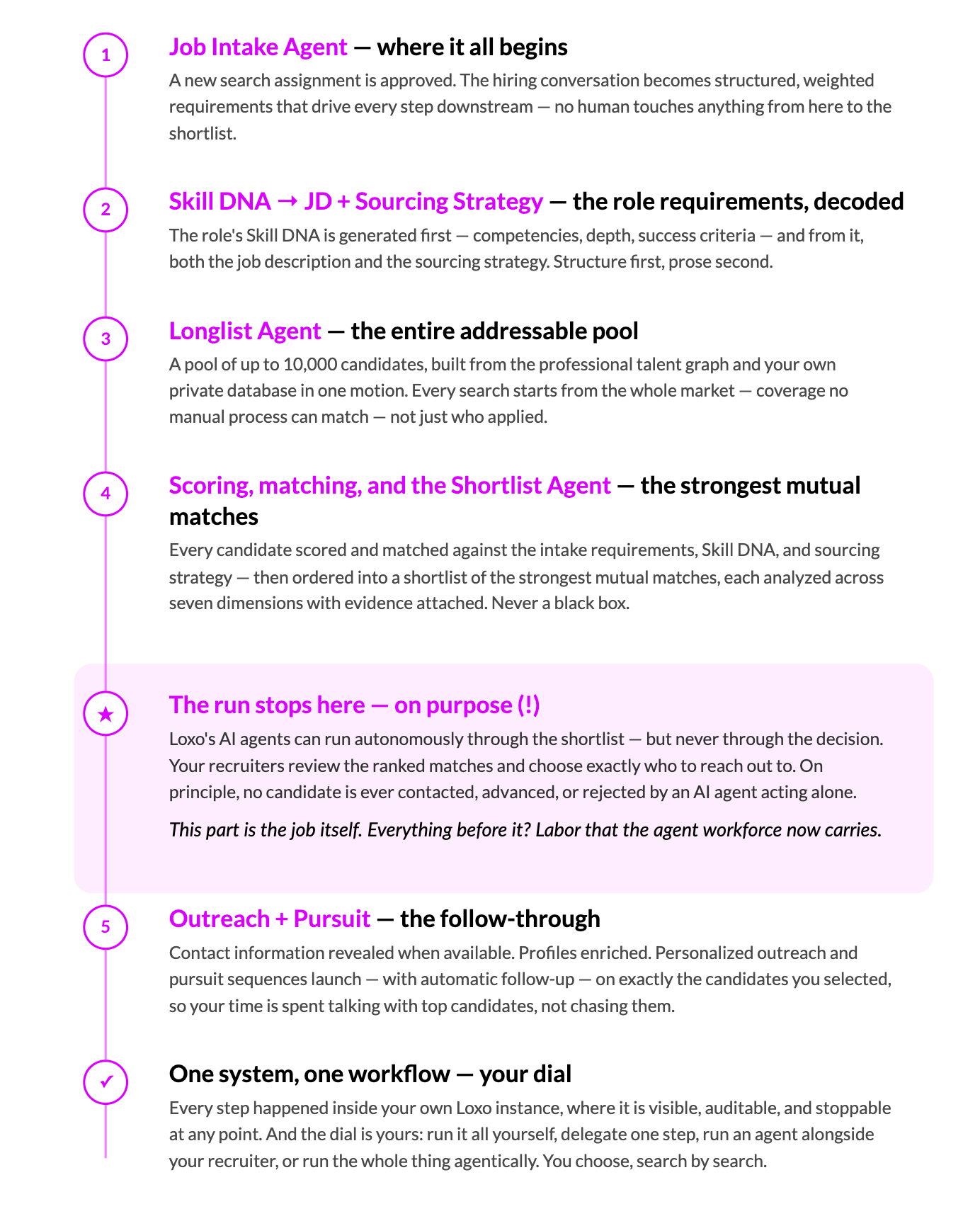
AI has an opportunity to fundamentally change recruiter productivity, and what’s unique about this release is how Loxo chose to design the product by making AI autonomy optional. Their proprietary agents are pre-trained on recruiting, work alongside recruiters in Loxo, to what they refer to as “a dial” the recruiter can control, whether delegating a single step, or running the whole search agentically. Basically, with Loxo, you can run a search autonomously through the shortlist. And ultimately, that’s how recruiters and recruiting software will be measured. The quality of the handful of candidates a recruiter submits. Yes, handful. Don’t expect recruiters to be submitting 15-20 candidates to a hiring manager. That’s wasteful. Expect to hear a lot more about yield ratios in the coming conference cycles.
The other part of this release which is absolutely massive, is the release of the Agent Impact Center, which quantifies ROI. Yup. Showing the work completed, and hours of labor absorbed by AI, which does in fact matter. The variables within recruiting are Time, Quality, Quantity, and Cost, so yes, quantifying labor hours saved is significant. We’re past the AI adoption phase and the industry has moved on to quantifying how AI is producing meaningful work output. With Loxo, you can use their executive dashboard to filter by agent, user, or time period to see the full picture across the team, drill down to a single recruiter, a specific agent, or a defined window of time to understand where AI usage is compounding and where it isn’t. Because let’s be honest. You don’t need AI to recruit. You can very well recruit with a piece of paper, a phone, and some data enrichment. This is the beauty of recruiting. It’s understanding the needs of each search to quickly deliver the shortlist to a hiring manager, assess accurately, and convert efficiently. Loxo’s Agent Impact Center is a huge first step toward evolving the conversation around the ROI of AI in recruiting. I’m here for it.
But of course, we can’t talk about AI recruiting without addressing the who. With so many vendors moving into the recruiting software space because of massive total addressable market (TAM), no wonder venture capital is targeting work tech and investing in young engineering prodigies to go build something on the back of frontier lab APIs. For HR, some estimates forecast a 10% Compound Annual Growth Rate by 2031.3 Which is huge. Whenever I read these figures, all I see is innovation, new products, better features.
But for talent acquisition leaders and recruiting agency owners it can be a bit dizzying to keep up. Fundamentally, buyers trust people building in HR who have experience. Hands down. Buyers in HR don’t want to talk to someone in their 20s making hyperbolic claims about their recruiting tech when they have little to no recruiting placement experience, nor the benefit of time to integrate labor market patterns into the product. Yes, this is where the role of advisors comes in, however, that’s not the same as a founder having this innate knowledge, as they’re dedicated to building the product full-time. Crowd sourcing experience to understand the nuance of shortlist indexing isn’t the move to trust in rec tech. Experience matters. Filling reqs matters. Peel back all the marketing, events, referrals, and the only thing standing is the product? That’s where the true builders will prevail. Because let’s be honest, recruiters aren’t afraid to address what I just said head on. Our literal job is putting our money where our mouth is. If sourcing tech founders think they can sell a recruiting agency owner that easily they should not be building need to have tech. There’s plenty of “nice-to-have” hr tech that gets sold (and acquired) that way. The beauty of measuring recruiting software head to head vs. comparison pages on a marketing site (or just taking a recruiter’s word for it because they liked their swag at a conference) is that it’s cheap. Just go A/B test your AI sourcing tool and compare the shortlists. It’s that easy. Anyone can build a talent graph that indexes Software Engineers from Google in San Francisco. (That’s literally the search every sourcing vendor demos by the way.) So to quote, Ilia Cheishvili, CTO at Loxo, “Let’s go for real.”
Matt Chambers and Ilia Cheishvili have spent 14 years building recruiting technology, and Loxo has grown to 150 employees following their growth investment in 2025 from Tritium Partners.4 Plus they’re training their own models. So there’s that. With this release they’re unveiling their own deep-learning talent graph of more than 850 million professionals, more than 50 proprietary recruiting algorithms, and one unified system of record. Plus the AI Agent Impact Center to understand the ROI of AI that recruiting leaders have been desperately trying to prove.
Tl;dr: Loxo has founder-market fit.
Wrapping up, I’m left with a thought I think nearly every day…it’s never been a better time to be in recruiting. And this release elevated Talent Intelligence as a category and puts it’s own stamp on it. Glad to see Loxo putting recruiters to work. Will be eager to hear what you think about it.
»Check out Next Generation Loxo and stay tuned on LinkedIn to see more of Building the Talent Machine’s coverage of this release.
https://mitsloan.mit.edu/ideas-made-to-matter/agentic-ai-explained
https://feld.com/archives/2015/01/illusion-product-market-fit-saas-companies/
https://www.mordorintelligence.com/industry-reports/hr-tech-market
https://www.prnewswire.com/news-releases/talent-intelligence-innovator-loxo-secures-growth-investment-led-by-tritium-partners-in-a-115m-transaction-to-accelerate-ai-and-product-development-302380908.html


