

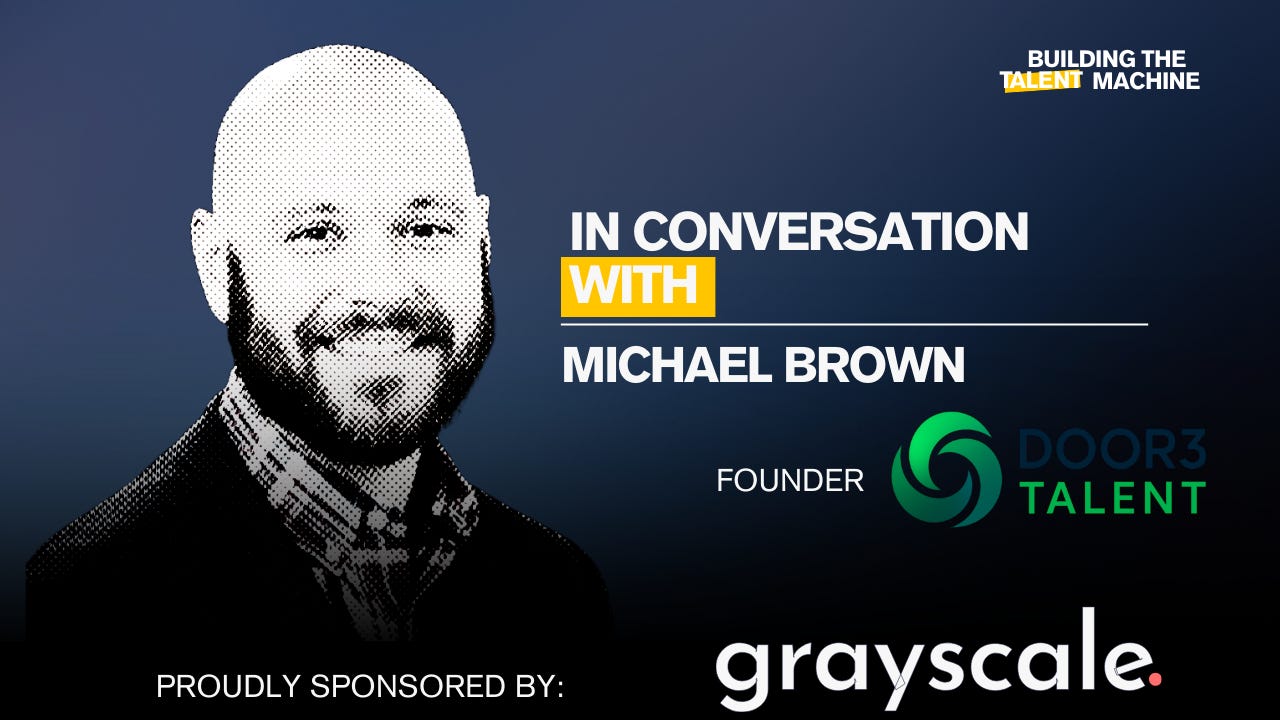
Michael Brown has built the talent machine for more than twenty years as a hands-on recruiting leader at companies like Snyk, Toast, and Acquia. He’s the founder of Door3Talent, where he works as a fractional TA leader, executive search partner, and AI recruiting concierge for growing teams.
Lately, Mike’s been deep in the weeds helping startups build real talent ladders and integrate AI directly into manager workflows as a practical recruiting operations tool. He’s also guided companies through high-stakes moments and has unique experience around M&A as talent strategy.
Mike is someone who’s actually done the work, at scale, in the moments that matter most. But more than that he’s a mentor, coach, and battle-tested recruiting leader who doesn’t shy away from the work itself.
He and I spent most of the conversation getting practical about what actually creates leverage in modern recruiting. The only problem? I forgot to hit record.
For nearly an hour we talked about how teams need to be deliberate about what work should be AI-led versus human-led, and why starting with the biggest leverage points matters more than chasing shiny tools. Mike framed recruiting and interviewing as real skills that need to be practiced and developed over time, not instincts you’re just supposed to have. We also touched on regional differences and how recruiting culture shifts depending on where you work, with the East Coast tending to be more closed and competitive, and the West Coast generally more open and willing to share.
We used Toast and Snyk as concrete examples of what building a real talent machine looks like in practice. At Toast, Mike walked through how the TA Ops team invested heavily in structure through Greenhouse and analytics, paired with a strong focus on candidate experience and clear messaging around what’s in it for the candidate. We talked about how employer branding wasn’t just a slogan but something baked into the language and culture, including the “Toastified” tone and even billboard campaigns that led to real hires.
At Snyk, the conversation shifted to scale and predictability. Mike joined when the company was around nine hundred people and helped move hiring from a loose, reactive model to something structured and repeatable. He broke down why they ran two distinct hiring processes for engineering and non-engineering roles, how Tableau dashboards helped leadership understand hiring pace, and how early adoption of Gemini AI led to custom internal tools. We also covered operational changes like eliminating coordinators by rolling out Goodtime scheduling and building a global hiring strategy using LinkedIn Insights and Talent Neuron.
We wrapped by talking about community and career development. Mike shared his approach to mentorship and why he believes in asking big and asking directly, using his relationship with Toast CEO Chris Comparado as an example. We talked about how mentorship works best as a two-way street and why people actually want to help more than we assume. He also shared his involvement in the community, from serving on the House of Visionaries board to organizing the Boston TA and Ops user group.
The big takeaway for recruiters was simple and grounded. Stay open-minded and don’t box yourself into a single label. Embrace AI as the market shifts instead of resisting it. Build resilience, because change isn’t a phase in this work, it’s the environment.
Hope you enjoy reading the conversation with Mike. Pretend it’s like a long form newspaper article. Remember those?
Brandon Jeffs: Where are you based and what are you working on right now?
Mike Brown: I am based outside of Boston in lovely Natick, Massachusetts. And I’ve actually been working with a startup on a myriad of rec ops–related projects—talent ladder, rec approval system, things like that.
Brandon: You call yourself a “recruiting concierge.” What does that mean to you?
Mike: It’s kind of a play, but I’ve gotten to a place in my career now—I’ve been at this for a little bit, 20 plus, I guess that’s where the grays come from here, the beard. But I think for me, I’ve gotten to step through a lot of different things. And so at this point, I get a lot of satisfaction from guiding others through the pitfalls and things that I’ve learned and helping them move faster.
Brandon: You’ve been recruiting for 20 years. How has the market evolved from your early days to now?
Mike: It is kind of interesting, and you can kind of relate it to some of the previous iterations in the market. I was around for the digital transformation, so the whole push for SaaS-based technology and web technologies. When I first started, I was doing mainframe recruiting for banks and big insurance companies, and it has just become a whole different world now, and especially tools didn’t exist. And so we were doing things manually or building ugly custom spreadsheets and doing things the hard way.
Brandon: For early-career recruiters facing this new “big hairy AI” transformation, what will help them stand out?
Mike: I think it’s just trying to learn as much as you possibly can. Continue to read, continue to watch these podcasts, follow great people that are doing interesting things. And find a mentor. That’s been a big theme in my career, is finding others that have stepped through it, that are willing to share their experiences so that I can kind of take what they did and make it better for myself. Right. And that’s kind of the thing that I’ve been passionate about more recently, but the whole concept around open source and paying it forward, and I put out an idea, you make it better, then I get to take it back and make it better even again, right? And it’s like that trading back and forth, that’s just – it’s so cool to me.
Brandon: How has community and knowledge-sharing in recruiting changed over your career?
Mike: I would say that we were, pre‑pandemic, we were on a really nice climb where people were starting to share ideas and come out of their shell, I would say. Pre that stage, there was this whole “knowledge is power” thing—that you built your recruiting stack and you had a specific way you were doing it and you held that thing close to the vest and you didn’t share, and that was your power. And then quickly, I think that got democratized by the market. People started to share. But then COVID hit and we all went back into our shell a bit because we didn’t know what to do. But now we’re back in this land of community. I’ve been embracing it myself. I love getting out there and in front of people. It’s kind of, I guess, part of being a recruiter. But I’m part of the board for House of Visionaries, so that’s one that has been actually really helpful for me in my new venture with Door3Talent, but also just meeting great people and networking, actually, with what happens to be a lot of my friends. So that’s been a great experience. And then I guess in past lives, there’s a fun group that we probably should spin back up that we called the Botato, and it was the Boston TA & TA Ops user group. And we had a few hundred people that would go, but it’s fizzled since, so it’s probably time to spin that back up.
Brandon: You’ve mentioned “rec ops” and TA ops a few times. How do you define rec ops?
Mike: For me, it’s essentially the person that is responsible for the operations of the TA team. I tend to view TA, and the best TA programs, like a product or like a business, right? And you have to have a well‑oiled machine under the scene or behind under the covers that’s going to have the right system parameters and give you that repeatable process and give you the opportunity to accelerate faster and have all the right tools. And then also somebody that’s going to be there to help enable that world—tends to be the person that helps onboard the TA partners and really kind of upskill and up‑level them.
Brandon: When recruiters go looking for mentors, especially 3–10 years into their career, how should they approach it?
Mike: Go big. Go big and find somebody that, to your point, that you think does it really well. And again, to your point, they don’t have to be a recruiter. One of my best mentors is a guy named Chris Comparato. He was the CEO of Toast, and before that, he was the SVP of customer success at Acquia, where I was supporting him as his recruiter. And so I built this relationship, and he kind of took me under his wing. It’s been a world of help in terms of advice and connection, and also it’s a two‑way street as well. And so I think that’s really a great way to do it. But you gotta go out and be brave. You gotta ask. I would say start with a relationship, don’t go with somebody that’s just flat‑out cold. Or ask for an introduction. If you think somebody is the bee’s knees and you want to kind of start to learn from them, finding that common connection so that you can get that introduction could be a really interesting thing. And man, I’ll tell you because I’ve been asked to do it before, it feels good to be asked to be a mentor, right? You feel propped up and you feel really good about it. So I’d say just go ask and be brave.
Brandon: You’ve recruited on both coasts. What differences do you see between East Coast and West Coast tech cultures?
Mike: 100%. Yeah. I’ve always said that East Coasters are very closed and West Coasters are open and they want to help. And it’s interesting, especially in the recruiting world, because you’ll talk to candidates. You could ask two very similar candidates, one on the East, one on the West, the same question about, “Do you have any candidate referrals that you might be able to share?” I think you talk to some of the – in Boston, they’re like, “No.” Very clear no. But you talk to somebody on the West Coast, they’re like, “Well, let me think about it,” or, “Actually, let me connect you to somebody.” It’s just a much friendlier connection there. I think the VCs differ pretty considerably just in how they operate, what they invest in, what their expectations are. I think the willingness to potentially spend is sometimes a little different too, I found, because I have worked on both coasts. More justification, business‑kind of more of a cutthroat on the East Coast. I think on West you just get a little bit more of a laid‑back vibe. I also did work for a consulting company for some time that had a pretty large Colorado office, and I would have to say that that Colorado office took powder days all the time. And so yeah, man, I was jealous. Super jealous. We did not get powder days in Boston, I’ll tell you what.
Brandon: You’ve seen companies ride big waves of innovation—SaaS, digital transformation, now AI. If that’s true, why do so many companies still struggle with hiring?
Mike: Oh, that’s a great question. And I’m trying to solve that as much as I possibly can. I think it comes down to just broken process, broken strategy. I think a lot of companies get swept up in shiny‑object tools and trying to Band‑Aid solutions with tools or dropping a tool into an existing process and expecting that the tool is going to be the solution for the existing process without changing the process. So where I’ve been spending a lot of time with companies is helping them define their strategy, taking their existing strategy, helping them determine what should be AI‑led, what should be human‑led, then helping them determine what are the biggest rocks, because you can’t go and you can’t tackle everything and do it really well. And so what are those biggest leverage points where you want to lease it out to AI, essentially. And I think you see, at the end of the day, it’s poor signaling. I think that people just kind of forget that this is a skill that has to practice, too, right? Recruiting, interviewing and being a talent spotter. You don’t just get to do it a couple of times and think you’re good at it. You’ve got to step through it. You’ve got to talk to a bunch of the duds, you’ve got to kiss the frogs, you’ve got to kiss the good ones too, right? So you know what good looks like. And so if you don’t have those experiences, I just think it becomes a no‑win game, regardless of AI or not.
Brandon: At Toast, you helped build what many people now think of as a “talent machine.” What did that look like from the inside?
Mike: Well, that was an interesting one. We were moving really fast there. A big focus, a big kudos goes to Lori Bush and her talent operations team. We put a lot into TA Ops and making sure that we had Greenhouse in a great structure and that we had even enablement person. We had somebody focused on analytics. We rolled people operations, people analytics into TA as well. We were a very forward‑thinking team. And we were really focused on experience—and not only a structured, consistent experience for candidates and interviewers, but just a great candidate experience. We focused a lot on the kind of quid pro quo or the WIFM, right, the “what’s in it for me” elements of the candidate to make sure that we were providing something different. Right. And that as they walked away, whether they got the job or not, they were feeling really good about Toast, and they were going to go tell their friends about Toast and the experience they had when they came to the office or the experience they had when they were talking to us virtually. It was a different experience. And then I think the other bit of that was branding. That was a huge piece of that machine. And kudos to the talent brand team. And Natalie Odell[o] was a big player there. Shout out to Natalie. And just building out essentially a new language. We Toastified—it basically turned into a Toast language, which was a pun‑heavy language where we played a lot on the toast pun, and we told a lot of people’s stories, and we talked a lot about the rituals at the company and celebrated all of that, and it became a magnet for people, especially in Boston. Everybody knew Toast, and I think everybody does now. And one thing that was really fun at the time, Brandon, was my first foray into billboard advertising. So we got to do a couple of billboards at the time that converted quite well. We actually got a couple of hires, I think, from it.
Brandon: You later joined Snyk around 900 employees. What was your mandate there and how did you approach it?
Mike: Yeah. I mean, the remit was to come in and essentially take Snyk from an uncalculated Wild West environment and bring them into the land of repeatable structure and predictability. And it was a wild ride, to be honest. In order to get to the final end zone, there were – we had some ups and downs in terms of layoffs and company changes and shifts. I think a lot of the focus over the time, to be honest, and where I gave kudos to the TA team over and over again, was their resilience. And it was actually a big focus that we looked for in the interview process when we hired recruiters, because we knew that there was always just going to be this constant change, whether it be a new product, a new location, a change in the market. The resilience element of people not always having to know and it always having to be black and white—that was really, really helpful.
A lot of it was data‑driven, right. So we focused a lot on the ops team and trying to structure our Greenhouse environment in a way that was very repeatable and consistent across as much of the business as possible. We essentially had two distinct processes that we got ourselves aligned onto: one for essentially engineering and then one for everything else. And then that allowed us to have very, very structured data. And we worked with our IT team to make sure that we could kind of centralize that data and then have really rich Tableau dashboards that ran off of that, that could give us predictability about hiring pace and were we on target and did we need to have more referrals or was our sourcing off because we were focused on one particular source over another, or based on particular geographies, what were the best sources to look at. And so we had a lot of intelligence over time.
I think the other piece of that was just focusing on trying to level the team up regularly. I’m a huge fan of making sure that the team has the latest and greatest and understands what’s going on in the world of AI. We spent a lot of time – I think we were pretty early adopters of Gemini. They rolled out corporate Gemini to the company, but never really did anything with it as an organization. And so I just latched onto it and just started figuring out what could we do with this thing. And so we got to a place where we productized and implemented Gemini and a bunch of custom Gems into our workflows. We invested in GoodTime and started using GoodTime for our scheduling. We saved a lot of money by using GoodTime. We actually shifted all of the coordinators that were on the team into the People Ops team. And so we didn’t have any – we had no coordinators on the TA team.
We did some big, hairy enterprise consolidation things. We shifted around our org structure a whole lot of different times. And it was super global, right. And so we were hiring all over the world. And so there was a lot of focus on our geo strategies and shifting the geo strategies over time, and new locations constantly, and LinkedIn Insights and TalentNeuron and all the tools, snagging as much data as I possibly could to try to figure out where we should go next or what were the right populations to go after. So it was a great opportunity, and I think at the end of the day, like I said, the team was super resilient, and that’s their secret sauce. They were great recruiters, but they were resilient at the same time and just willing to roll with it. I think part of it was that the market sucked. But at the same time, I think it was also because we created a great place and we worked with good people. And that’s what you want, right? It’s like, the experiences are kind of similar from job to job to job, but the people, that’s what’s different.
Brandon: You’ve called resilience “the secret sauce” for recruiters at scale-ups. What do you want recruiters to hear on that topic right now?
Mike: I would just say stay open‑minded. I give this advice a lot. I think I talk to a lot of recruiters and they think that they’re a tech recruiter, or they are a go‑to‑market recruiter, or they are this or that or some other thing, or they just do TA ops or they don’t do TA ops. I’m like, listen, you’ve got to be as open‑minded in this market as possible and be ready to adapt, right? Just be as open‑minded as possible, adaptive. As the market changes come, embrace AI and all the things will happen.
Brandon: For people who want to work with you or follow your work, where should they go?
Mike: Yeah, the audience can definitely find me on LinkedIn. I post regularly and contribute and comment regularly on LinkedIn. You can also go to my website, Door3Talent, to find out more about what I do.
Connect with Mike: https://www.linkedin.com/in/michaelbrown91281/
Special thanks to our sponsor, Grayscale. The AI Assistant for all your hiring needs. Grayscale helps you move fast, automate the busywork, and deliver an exceptional candidate experience, all from inside your ATS.
Try it today 👉
https://grayscaleapp.com/